
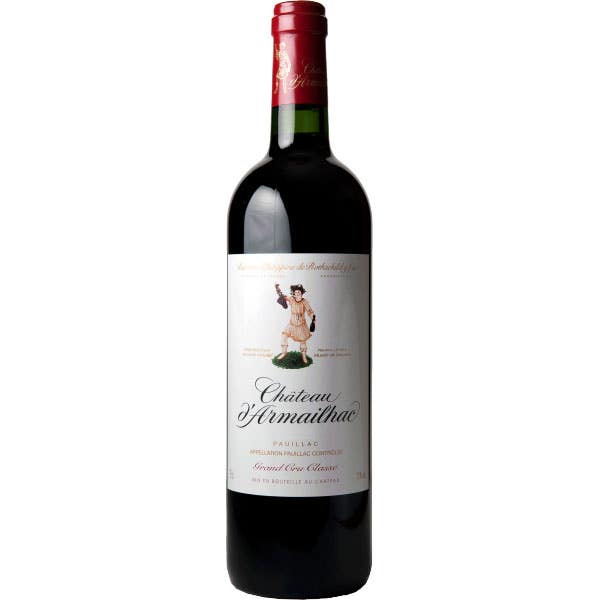

Château d’Armailhac 2010
• Domaine: Château d'Armailhac
• Appellation: Pauillac
• Classification: Fifth Growth
• Origin: Left Bank, Bordeaux, France
Château d’Armailhac neighbors the famous First Growth property, Château Mouton Rothschild. This 70-hectare vineyard hosts some very impressive terroir with mixtures of gravel, clay and limestone soil. Here, plantings of Cabernet Sauvignon, Merlot, Cabernet Franc and Petit Verdot thrive in a T-shaped vineyard. More than a few of these vines date all the way back to 1890 and are some of the oldest in all of Bordeaux. The vineyards were previously a part of the vast holdings of Nicolas-Alexandre de Ségur – the renowned Wine Prince - who simultaneously owned several First Growth estates including Château Lafite Rothschild, Château Mouton Rothschild, and Château Latour. Even prior to being classified as a Fifth Growth in 1855, the wines from Château d’Armailhac were renowned throughout France; the second wine often served at local taverns. The wines are friendly examples of excellent Left Bank terroir, and a perfect buy for value-oriented wine lovers.
Château d’Armailhac was initially a part of the vineyards that today comprise Château Mouton Rothschild. It was purchased by the d’Armailhacq brothers who were riverboat captains on the Gironde estuary. The wines were sold under the label Mouton d’Armailhacq, and the Armailhacq family spared no expense trying to churn out wines that were on par with the estate’s illustrious neighbors, Château Pontet-Canet and Château Brane Mouton - which later became Château Mouton Rothschild. Eventually they drove themselves into debt, and in one last ditch effort to revitalize the property, they decided to spend their income on rebuilding a château. They couldn’t afford to finish the property, and to this very day the château stands half-finished. This interesting looking building stands out from the other Pauillac properties piquing the interest of any who are fortunate enough to visit the estate. Eventually Baron de Rothschild purchased it in 1934 and Château d'Armailhac has been a part of the Rothschild holdings ever since.
After purchasing the property, the Baron expanded the vineyards at Château d’Armailhac by 24 hectares. The vines here are generally on the older side – ranging from an average age of fifty years. The estate has some of the greatest quantities of Cabernet Franc in the entire Médoc, and a lot of it is older vines. As the Cabernet Franc vines die off, they continue to increase their holdings of Cabernet Sauvignon. Stylistically they are known for lighter styled Pauillacs wines. This is probably because the majority of the vinification process for their grand vin takes place in stainless steel tanks, and the wines are aged in new oak barrels.
Château d’Armailhac has changed names many times throughout the years including Château Mouton d’Armailhac, Château Mouton-Baron-Philipe, and Château Mouton Baronne. Though many consider the wines of Château d’Armailhac on the lighter side, newer vintages pack a bit more of a powerful Pauillac punch. Regardless, these wines are best consumed when in their youth, and they are remarkably approachable. The later vintages have been steadily climbing in terms of quality, yet prices still remain fair. It is clear this Fifth Growth property is one of the greater values on the Left Bank.
Tasting Notes
"Tasted at the château, the 2010 D'Armailhac has a fabulous, opulent bouquet, with black cherries, boysenberry, almond and hints of cooked meat as it dabbles with secondary aromas. The palate is medium-bodied, with bold tannin, grippy in the mouth and immense weight. This is a very structured d'Armailhac, although it probably does not possess the finesse of the 2016, which I tasted alongside. There is great density here—tensile and bold, with a grippy finish. It is a long-term prospect. Tasted April 2017." - Neal Martin, The Wine Advocate (6/30/2017, Issue 231), Rating: 92, Drink: 2021-2040
"Another sensational effort from Philippe Dhaluin, the administrator of Mouton Rothschild, this blend of 60% Cabernet Sauvignon, 23% Merlot, 15% Cabernet Franc and the rest Petit Verdot shows complex floral notes intermixed with forest floor, camphor, black currants and mulberries that all jump from the glass of this aromatic style of d’Armailhac. This wine possesses very good acidity, a surprisingly higher percentage of Merlot than usual, but the quality is impressive, and the good news is that there are 20,000 cases of this full-bodied beauty, which should age nicely for 15-20+ years." - Robert Parker Jr., The Wine Advocate (2/27/2013, Issue 205), Rating: 93, Drink: 2013-2033
''Deep garnet in color, the 2010 D'Armailhac leaps from the glass with vivacious scents of baked raspberries, blueberry pie and kirsch plus hints of candied violets and pencil shavings. Medium to full-bodied, the palate has lovely energy with a lively backbone and well-played chewy tannins supporting the delicate flavors, finishing minerally.'' Lisa Perrotti-Brown, The Wine Advocate (03/05/2020) Ratings: 92 Drink: 2020-2042
| LWIN | 1006090 |
|---|---|
| Stock Status | Out of Stock |
| Appellation | Pauillac |
| Vintage | 2010 |
| Brand | Chateau d'Armailhac |
| Shipping Weight | 3.000000 |
-
 Château d’Armailhac 2015Special Price $84.95 Average US Price $94.00
 -
Château d’Armailhac 2006Special Price $96.95 Average US Price $99.00
-
 Château d’Armailhac 2017Special Price $56.85 Average US Price $63.00
 -
 Château d’Armailhac 2018Special Price $69.85 Average US Price $84.00
 -
 Château d’Armailhac 2019Special Price $66.85 Average US Price $77.00
-
 Château Cos d’Estournel 2009Special Price $392.82 Average US Price $421.00
 -
 Château Cos d’Estournel 2010Special Price $323.95 Average US Price $357.00
 -
 Château Pontet-Canet 2009Special Price $288.85 Average US Price $315.00
 -
Château Cos d’Estournel 2022Special Price $245.85 Average US Price $291.00
-
Château Cos d’Estournel 2019Special Price $216.85 Average US Price $234.00
