
Clos du Clocher 2003 Magnum

Only 6 left
SKU: 1204-2003-M
Size: Magnum (1.5 L)
Other Vintages We Offer:
• Domaine: Clos du Clocher
• Appellation: Pomerol
• Origin: Right Bank • Bordeaux • France
• Varietal: Cabernet Franc - Merlot
Clos du Clocher is a hidden gem in Pomerol. It was first acquired in 1924 by Jean Baptiste Audy, a negociant in nearby Libourne. In the decades that followed, the Audy family added more plots of land to their holdings. The estate is currently managed by Jean Baptiste Audy’s descendant, Jean Baptiste Bourotte.
Pomerol is a tight-knit and compact village on the Right Bank. The namesake appellation is the smallest in Bordeaux. Unlike other appellations, there has been little chance for extension or expansion in Pomerol. That is partly to explain why Pomerol produces some of Bordeaux’s most expensive wine (Pétrus, Le Pin, to name two). It has a minuscule 800 hectares and 135 growers. The village does not have a traditional center, nor any magnificent chateaux. The only landmark is the church on the plateau. Hence many estates in Pomerol are named with references to eglise (the church) and clocher (the bell tower). Paradoxically, Pomerol produces some of Bordeaux's most expensive wine.
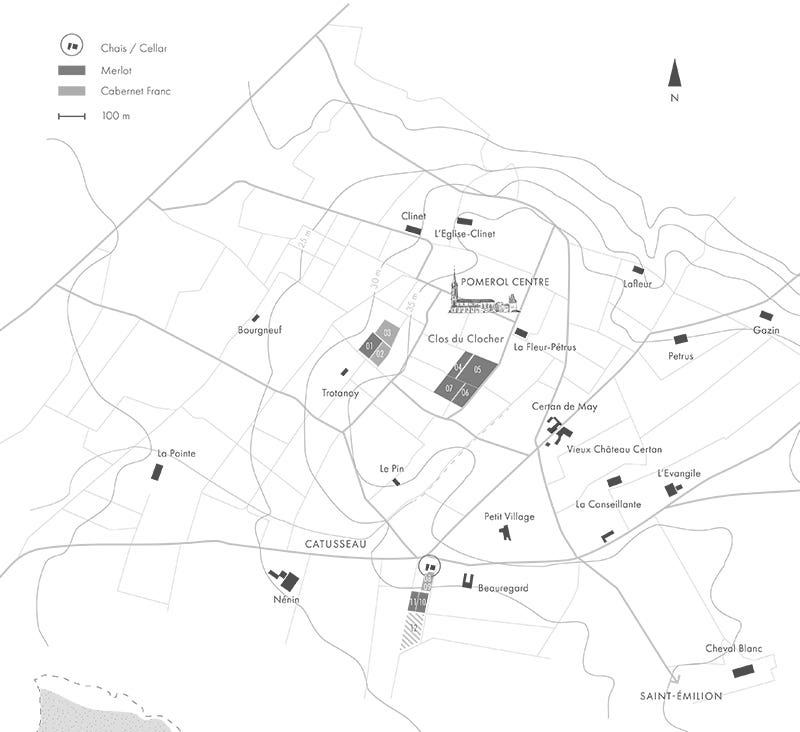
The highest quality plots are on the Pomerol plateau, a largely flat area 35-37 metres high in altitude. The owner of Petrus, Moueix family, defines any land above 30 metres as “high plateau”, which is the most sought-after plots in Pomerol. That is where Clos du Clocher’s largest plot is found. It is located by the church, which is the center of the prime plateau of Pomerol. Neighboring estates include Hosanna, Vieux Chateau Certan. Clos du Clocher’s other sizeable land holding is located next to Château Trotanoy.
Blue clay, the prized soil known for its iron rich quality, is found on Clos du Clocher’s land. It defines its terroir that is home to early ripening Merlot, and Cabernet Franc. The majority of their vines are on average 25 years old, with some oldest vines 60 years old, dating back to 1957. Everything is harvested by hand, and there is a very rigorous selection process.
Many Pomerol wines are made from early ripening merlot and approachable when young, Clos du Clocher almost always has 25% of Cabernet Franc in its wine, which requires more ageing in bottle before it can fully develop. The resulting wine can age for 20 years or longer.
Considering its overall quality and potential, we believe Clos du Clocher is a rare find among Pomerol that is still undervalued. For collectors who want to let the wine age, we recommend these vintages: 2015, 2016, 2018, 2019, 2020.
“Deep colour, almost inky, and although it doesn't display the same balance as the 2001, the tannins are full of Pomerol signature, with a satiny, gourmet feel, complete with chocolate and liqourice coating. You feel that you have dropped fully and completely into the appellation, helped perhaps by the slightly higher percentage of Merlot than usual. Fruits are black cherry and spiced raspberry, and it delivers a fresh lilt of acidity on the finish. A hot year, one of the earliest flowerings on record and temperatures that climbed to 40C in August and September, and here the blue clays of Clocher really helped.” - Jane Anson, Jane Anson, Inside Bordeaux (June 2024), 92/100
| LWIN | 1008300 |
|---|---|
| Stock Status | In Stock |
| Appellation | Pomerol |
| Vintage | 2003 |
| Brand | Clos du Clocher |
| Shipping Weight | 8.000000 |
About Pomerol
Laguna Cellar Insider List
First access to allocations & new arrivals
Critic picks and tasting notes — a short letter, sent when there is something worth opening. Unsubscribe any time.